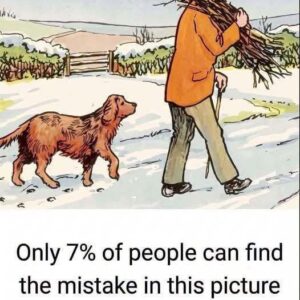
A man walking his dog through freshly fallensnow should leave behind a clear andrecognizable trail of footprints. His boots pressinto the soft snow, while his dog’s paws create asmaller set of impressions beside or around hisown. Together, these marks should tell a simplestory of two companions enjoying an ordinarywinter walk.
At first glance, nothing about the surroundinglandscape appears unusual. There are nostrange objects, hidden figures, or obviouswarning signs to distract the observer. The manand his dog seem perfectly normal, and thesnowy setting gives the impression of a peacefuloutdoor adventure.
However, the real mystery is not found in theman or the dog themselves. Instead, the puzzleencourages viewers to look carefully at thefootprints left behind them. Somewhere alongthe trail, a small inconsistency is believed toreveal that something is not quite right.
The challenge is to examine how the two sets offootprints relate to each other. A person walkingshould leave impressions that follow areasonably consistent direction and pattern.Similarly, a dog moving alongside its ownershould leave paw prints that make sense inrelation to the man’s movements.
Even a tiny detail could potentially change theinterpretation of the entire scene. Perhaps thedistance between the footprints seems unusual,or the arrangement of the tracks does not matchthe movements expected from two walkingcompanions. Such details are often central tovisual observation puzzles.
However, there is one important limitation: theavailable description does not explain exactlywhat the footprints look like. It does not identifya missing paw print, an unusual boot impression,or an impossible sequence of tracks.
Consequently, claiming that a particular footprintis missing or that the trail reveals an impossiblemovement would be speculation. Without theactual image or a detailed explanation of thepattern, no definite solution can be established.
Ultimately, this snowy mystery highlights theimportance of careful observation and criticalthinking. The footprints are supposed to containthe answer, but the essential evidence ismissing. Recognizing that limitation is just asimportant as spotting an inconsistency, becausenoticing a mystery and genuinely solving it aretwo very different things.